Case management for diocesan marriage tribunals
LexTribunalis keeps a tribunal's causes in one place. It counts time limits by the canons and shows what is overdue, makes letters and decrees from your own Word templates, and counts the figures for the annual reports to the Holy See from the record.
It is built by Richard Verver, JCL, a canon lawyer who has worked in a tribunal since 2015. It is in early access: one diocesan tribunal in Ontario is using it, and a few more are welcome to join.
Ask for a demonstration Each part in detail, with pictures
What it does today
Time limits
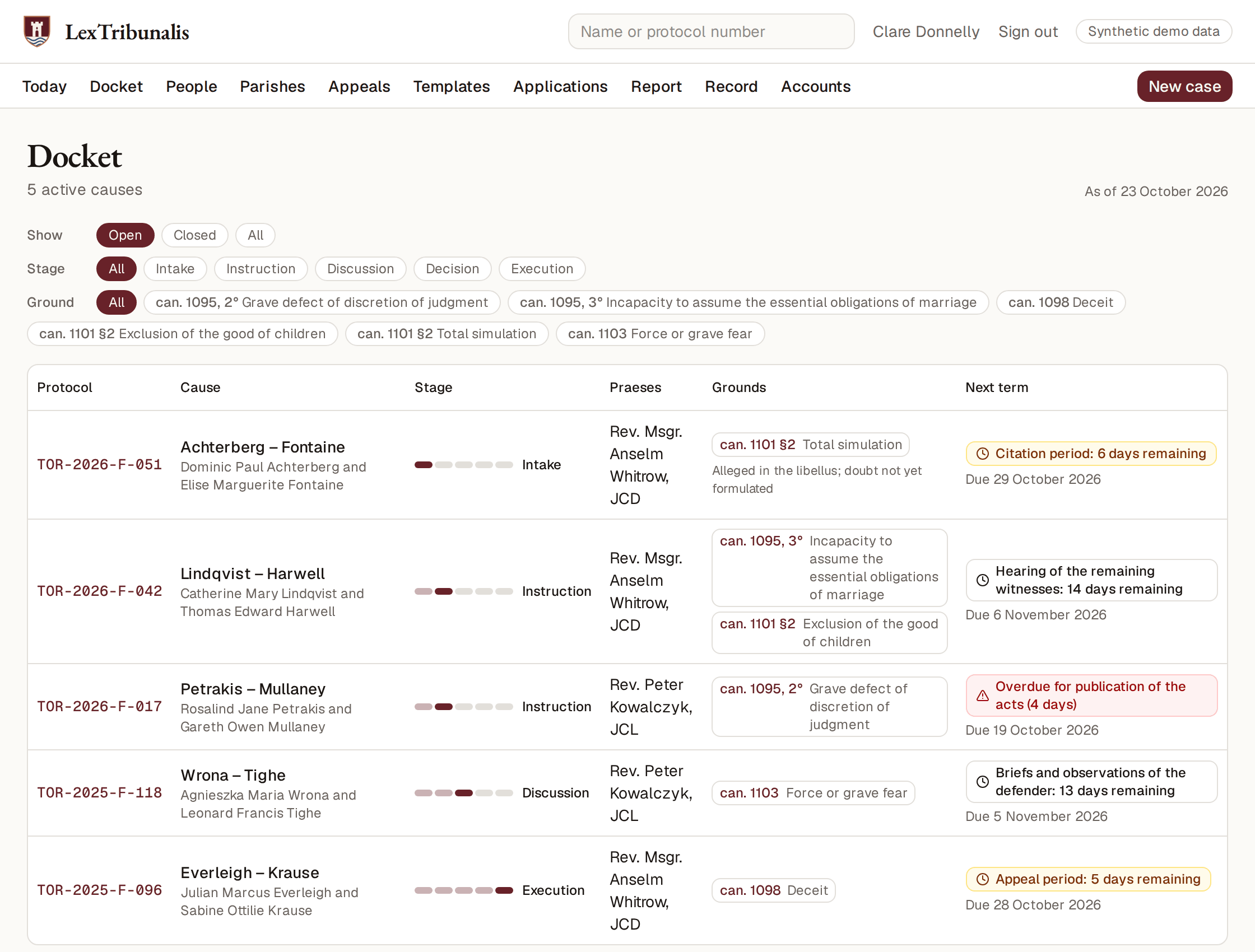
When a step is recorded, the time limits that follow from it are opened and counted by the canons on the computation of time (cann. 200 to 203), and one that would expire on a day the tribunal is closed runs to the next open day (can. 1467). Each shows the canon it rests on. One page lists what is overdue and what falls due in the next two weeks, across every open cause.
Letters and decrees
They are made from the tribunal's own Word files, on its own letterhead. Staff add, replace and retire templates themselves, without asking a developer. A template with a misspelt field is refused when it is added.
The annual reports
The figures for the report to the Apostolic Signatura and the questionnaire of the Secretariat of State are counted from the record, line by line as on each form. Each number opens to show the causes behind it.
The processes
The ordinary, briefer and documentary processes are provided for. A cause keeps the procedural law it was introduced under.
Access, from the office or outside it
It is used in a web browser, with nothing to install. A judge, defender of the bond or advocate engaged for one cause signs in from wherever they work, with a password and a code from an authenticator app, and sees that cause and no other, and can print its acts to read on paper.
A record of every change
Every change, every sign-in, every document opened and every copy of the acts printed is recorded, with who did it and when. Each entry is sealed to the one before it, so that an entry changed, removed or slipped in afterwards is found out when the record is checked against a copy of its latest seal kept elsewhere.
- Who is behind it
Richard Verver, JCL, a canon lawyer in Toronto. He is its only developer and gives the support himself. A tribunal's agreement is with him personally, as a sole proprietor. The tribunal in Ontario that uses it is not the one he works in. What a tribunal holds if he stops is set out next. About
- If he stops, or a tribunal wants to leave
If he is ill or away, nothing stops working: the system runs on the tribunal's server and depends on nothing of his, and it comes with a written guide to restarting, backing up and restoring it without him. The records are in formats that can be read without their maker: an ordinary database file and Word files. The tribunal also receives the source code, which is the program's own text, and may go on using it and having it changed for itself. A graph of the procedural law, from the Code, Dignitas connubii and Mitis Iudex, against which such changes can be checked, is being built. Yours to change
- Where the records are kept
It can be installed on a server the diocese owns, so that the records stay in the tribunal's keeping. The original documents in the acts are stored encrypted, under a key the diocese holds. A diocese that would rather not run a server itself can have one arranged. The provider, the country the server is in, who has administrative access to it and what it costs are agreed with the diocese in writing beforehand. The facts for a diocesan IT department
- What it costs
A tribunal owns its copy and does not rent it: Richard is paid for his work, and not for controlling access to the system. One payment buys a licence to use the system without limit of time. There is no yearly fee to keep it running. Later updates can be bought as they come. Security fixes are not charged for, for as long as he maintains the system. When the procedural law changes, a tribunal is not obliged to buy the update. The steps and time limits are written out in the source it holds, and it can make the change itself, have someone make it, or buy Richard's version. Early users pay less, and the price is quoted in writing after a demonstration. What early access means
- What is not there yet
- Bringing in the records of an existing system. This is the next thing to be built; until then a tribunal begins with its new causes and enters the open ones by hand.
- A single export of everything, for taking to another system.
- The administrative procedures (lack of form, the Pauline privilege, the favour of the faith, ratum et non consummatum, presumed death) and the separation of spouses. They are in a first version, still under review.
- Hearing a cause in second instance.
- Languages other than English.
- An independent security review.
- Artificial intelligence
There is none in what a tribunal receives today. An assistant is planned that would make a first index of a deposition: dated facts, each shown with the passage it was drawn from, for a person to accept, correct or reject one at a time. It would run on a machine at the tribunal, so that no deposition leaves the tribunal. It would not weigh evidence, propose a decision, or write a votum or a sentence. What is planned
Ask for a demonstration
A demonstration is given by video call. It costs nothing and commits a tribunal to nothing. Write to richard@lextribunalis.com, or use the form.